
Credit Age Calculator
Track your credit history length
Calculate the average age of your credit accounts and understand its impact on your credit score.









Credit Age Calculator
Track your average age of accounts (AAoA)
About Credit Age Calculator
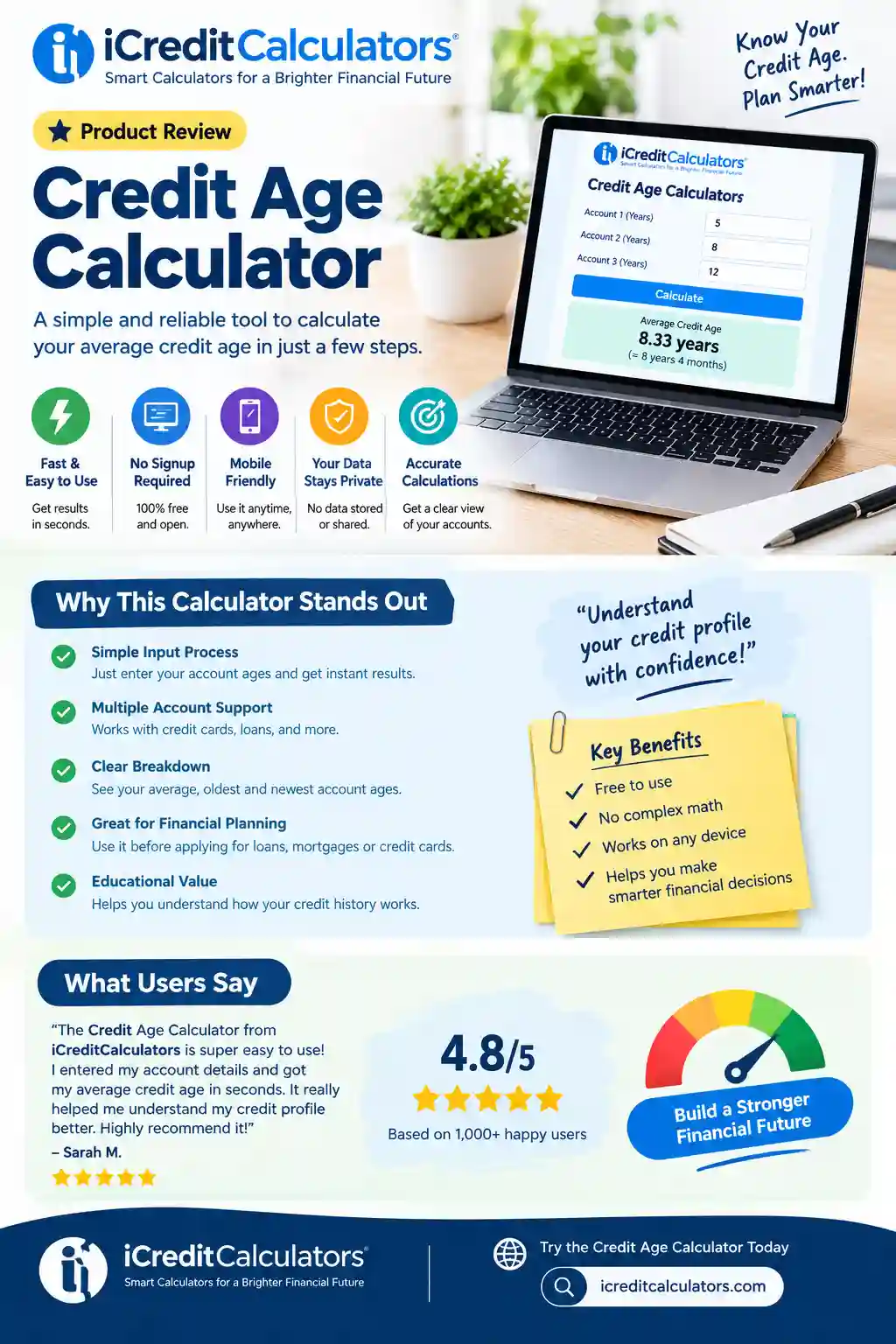
The Credit Age Calculator is a free online tool that helps you track your credit history length. Whether you're planning to apply for credit, managing existing debt, or simply want to understand your financial position better, this calculator provides instant, accurate estimates with detailed visual report and actionable recommendations.
What to Do Next?
Based on your analysis with the Credit Age Calculator, these tools will help you execute the next phase of your financial plan.
Credit Age Calculator From iCreditCalculators

Credit Age Calculator From iCreditCalculators
If you are trying to understand the age of your credit accounts, how to calculate credit age with a credit age calculator is an important question because your credit history is more than just a number on a credit report. The age of your accounts can help you understand how long you have been managing credit and how your overall credit profile may look to lenders.
The iCreditCalculators Credit Age Calculator gives you a simple way to work through account-age calculations without relying on manual arithmetic. This guide explains what credit age means, how the calculation works, how to use the calculator, and how to interpret the result without confusing credit age with your entire credit score.
About the Credit Age Calculator
Credit can become complicated when you have several credit cards, an auto loan, a mortgage, a personal loan, or other accounts that were opened at different times. Looking at each account individually may tell you when that particular account began, but it does not immediately tell you the average age of your credit accounts.
That is where a credit age calculator can be useful.
The iCreditCalculators Credit Age Calculator is designed to help consumers calculate credit-account age using account information. The calculator is part of iCreditCalculators' broader collection of free financial calculators covering credit, loans, mortgages, debt and other personal-finance calculations. (iCredit Calculators)
Instead of reaching for a calculator app, writing down several dates, converting years into months and checking your arithmetic several times, you can use a dedicated tool to make the calculation easier to follow.
This can be useful for a wide range of people:
- Someone who is building credit for the first time.
- A consumer preparing to apply for a credit card.
- A homebuyer reviewing their credit before a mortgage application.
- Someone planning to finance a vehicle.
- A borrower reviewing their credit before applying for a personal loan.
- A business owner who wants to understand their personal credit profile before seeking business financing.
- A consumer who wants to understand why opening several new accounts can change the average age of accounts.
The calculator is not intended to replace a credit report or a lender's underwriting process. Instead, it is a practical calculation tool that helps you understand one specific part of your credit profile.
Why credit age deserves attention
Credit age is often discussed alongside credit scores because length of credit history is one component used by FICO scoring models. FICO states that length of credit history accounts for 15% of a FICO Score. It also says that the scoring calculation considers how long accounts have been open, including the age of the oldest account, newest account and average age of accounts. (myFICO)
That does not mean that 15% of your score is simply determined by one number produced by a credit age calculator.
A credit score is calculated from multiple pieces of information, and different scoring models can use information differently. Credit age should therefore be viewed as one part of a larger credit picture.
For example, imagine two consumers:
- Consumer A has an average account age of eight years but has several recent late payments.
- Consumer B has an average account age of three years but has consistently paid bills on time and maintains responsible revolving-credit balances.
The first consumer has the longer account history, but that fact alone does not tell you which consumer will receive a particular credit score. Other credit information matters too.
That is one reason a credit age calculator should be used as an educational and planning tool, rather than as a credit-score predictor.
What Is a Credit Age Calculator?
A credit age calculator is a financial calculator that helps determine the age of credit accounts and, where multiple accounts are considered, the average age of those accounts.
At its simplest, the calculation takes the ages of the relevant accounts, adds them together and divides the total by the number of accounts.
For example, suppose you have three accounts:
- Credit Card A: 9 years old
- Credit Card B: 6 years old
- Auto Loan: 3 years old
The average age would be:
(9 + 6 + 3) ÷ 3 = 6 years
So the average age of these three accounts is 6 years.
The important point is that the average credit age is not the same thing as the oldest credit age.
In this example, the oldest account is nine years old, while the average age is six years.
Both numbers can provide useful information, but they answer different questions.
Credit age and credit history are not identical
People sometimes use the phrases credit age, credit history length, oldest account age, and average account age as though they mean exactly the same thing.
They do not.
Your oldest account tells you how far back the oldest account on your credit history goes. Your average account age looks across the accounts included in the calculation and produces an average.
FICO specifically identifies the age of the oldest account, age of the newest account and average age of accounts as considerations within the length-of-credit-history category. (myFICO)
That distinction becomes particularly important when you have many accounts.
For example:
Account ages: 12 years, 10 years, 8 years, 2 years and 1 year.
Your oldest account is 12 years old.
But your average age is:
(12 + 10 + 8 + 2 + 1) ÷ 5 = 6.6 years
Therefore, saying that your "credit age is 12 years" would not accurately describe the average age of all five accounts.
The calculator helps make this distinction easier to understand.
How Credit Age Relates to Your Credit Score
Credit age matters because lenders and scoring models are interested in your experience managing credit, but credit age is not your credit score.
The Consumer Financial Protection Bureau explains that credit reporting companies commonly use length of credit history as a factor in determining credit scores and that longer experience managing credit responsibly can contribute to a stronger credit profile. (Consumer Financial Protection Bureau)
FICO provides a more detailed explanation. Its scoring information says that the length-of-credit-history category considers how long credit accounts have been open and specifically includes the oldest account, newest account and average age of accounts. (myFICO)
This means a person should not look at a credit age calculation in isolation.
Other factors can include:
- Payment history
- Amounts owed
- Credit utilization
- New credit
- Credit mix
- Length of credit history
The relative importance of these factors can vary by scoring model and individual credit profile.
A simple example
Suppose someone has an average account age of seven years.
That sounds like a substantial credit history, but the person may still have issues such as:
- High balances on revolving accounts.
- Recent missed payments.
- Several recent credit applications.
- Errors on a credit report.
- A limited mix of account types.
The seven-year average does not erase those other factors.
Conversely, a consumer with a relatively short credit history can still establish a healthy credit profile by managing accounts responsibly. FICO itself notes that people with shorter histories can still have high FICO Scores when the rest of their credit report is strong. (myFICO)
This is why the calculator should answer one question—how old are the accounts included in my calculation?—rather than attempting to answer every question about your creditworthiness.
Formula to Calculate Credit Age
The basic average-age calculation is straightforward.
Average Credit Age Formula
Average Credit Age = Total Age of Credit Accounts ÷ Number of Credit Accounts
If you work with months instead of years, the calculation becomes even easier to perform accurately when account ages include partial years.
Average Credit Age in Months = Total Account Age in Months ÷ Number of Accounts
You can then convert the result back into years and months.
Formula and abbreviation table
| Formula Term | Abbreviation | Explanation |
|---|---|---|
| Average Credit Age | ACA | The average age of the credit accounts included in the calculation |
| Total Age of Accounts | TAA | The combined age of all accounts included |
| Number of Accounts | N | The total number of accounts included |
| Account Age | AA | The age of an individual credit account |
The formula can therefore be written as:
ACA = TAA ÷ N
For example, assume three accounts have ages of 84 months, 60 months and 36 months.
First add the account ages:
84 + 60 + 36 = 180 months
Then divide by the number of accounts:
180 ÷ 3 = 60 months
Convert 60 months into years:
60 ÷ 12 = 5 years
The average credit age is therefore 5 years.
Why use months?
Years are easy to understand, but months can provide greater precision.
Consider two accounts:
- Account A = 5 years 6 months
- Account B = 3 years 6 months
If you simply round both to whole years, you could lose useful information.
Using months:
- 5 years 6 months = 66 months
- 3 years 6 months = 42 months
Then:
(66 + 42) ÷ 2 = 54 months
54 months equals:
4 years 6 months
This gives a more precise result than using rounded whole-year figures.
Important Point About Credit-Age Calculations
A calculator result is only as accurate as the information entered.
If you enter an incorrect opening date, omit an account, include an account twice, or use an estimated age instead of the information shown on your credit report, the resulting average may not accurately represent your accounts.
For the most useful calculation, start with reliable account information.
Your credit reports can be especially useful for this purpose because they contain account-level information that helps you identify when accounts were opened and how they have been reported.
You should also remember that a calculator's mathematical result is not necessarily the same thing as a credit-scoring model's internal calculation.
Credit-scoring companies use proprietary methods, and different scoring models may treat information differently. The purpose of the calculator is to help you understand the underlying numbers, not to reproduce a proprietary scoring algorithm.
How to Use the Credit Age Calculator
Using a dedicated calculator is generally easier than manually calculating several account ages.
Before starting, gather the account information you need.
For a US consumer, useful sources may include your credit reports, account statements and information provided by your financial institutions.
How to use this calculator step-by-step
Follow these basic steps:
- Open the iCreditCalculators Credit Age Calculator.
- Review your credit-account information before entering numbers.
- Identify the age of each relevant account.
- Enter the account-age information requested by the calculator.
- Check each entry carefully before calculating.
- Run the calculation.
- Review the average credit age displayed by the calculator.
- Compare the result with your own account information to make sure there are no obvious omissions or duplicate entries.
- Use the result as part of your wider credit review, rather than treating it as your credit score.
You can access the calculator directly through iCreditCalculators' Credit Age Calculator.
Step 1: Gather your account information
Start with the accounts you intend to include.
Depending on the purpose of your calculation, this could include credit cards, installment loans and other accounts that appear on your credit history.
Do not guess when a reliable date is available.
For example, if you believe a credit card is "about five years old," but your credit report shows that it was opened five years and eight months ago, the latter figure provides a more precise basis for your calculation.
Step 2: Identify each account's age
You need the age of each account that will be included.
For example:
| Account | Age |
|---|---|
| Credit Card A | 8 years |
| Credit Card B | 5 years |
| Auto Loan | 3 years |
| Credit Card C | 2 years |
The total age is:
8 + 5 + 3 + 2 = 18 years
There are four accounts.
Therefore:
18 ÷ 4 = 4.5 years
The average is 4 years and 6 months.
Step 3: Enter the information carefully
If the calculator asks you to enter account ages, check that you are using the correct units.
Do not accidentally enter:
- Months as years.
- Years as months.
- A current balance instead of account age.
- A credit limit instead of account age.
- The date of your most recent payment instead of the account-opening date.
A simple data-entry mistake can produce a mathematically correct result from financially incorrect information.
Step 4: Review the result
Once the calculation is complete, look at the result in context.
Suppose your calculator shows an average credit age of 4 years and 3 months.
That means the mathematical average age of the accounts you entered is approximately four years and three months.
It does not automatically mean:
- Your credit score is good.
- Your credit score is bad.
- You will qualify for a mortgage.
- You will qualify for a particular interest rate.
- A lender will approve your next application.
Those decisions depend on substantially more information.
How the Credit Age Calculator Works
The underlying mathematics is simple.
Imagine that a consumer has four accounts with the following ages:
- Account 1: 96 months
- Account 2: 72 months
- Account 3: 48 months
- Account 4: 24 months
Add them together:
96 + 72 + 48 + 24 = 240 months
There are four accounts.
Divide:
240 ÷ 4 = 60 months
Convert months to years:
60 ÷ 12 = 5 years
Therefore, the average age of the four accounts is 5 years.
The calculator essentially saves you from having to repeat this process every time you want to test a different set of account ages.
What happens when you add a new account?
This is one of the most useful scenarios to understand.
Suppose your existing accounts have ages of:
- 10 years
- 8 years
- 6 years
The average is:
(10 + 8 + 6) ÷ 3 = 8 years
Now suppose you add a brand-new account that is effectively 0 years old for this simplified example.
Your new average becomes:
(10 + 8 + 6 + 0) ÷ 4 = 6 years
The average falls from 8 years to 6 years.
That does not mean opening a new account automatically causes a specific number of credit-score points to disappear. It simply demonstrates the mathematics of an average.
A real credit profile is more complicated, and scoring models consider several factors at the same time.
Why the average changes
The reason is simple: a new account is much younger than the existing accounts.
Whenever you add a value that is below the current average, the average generally moves downward.
For example, if your current average account age is eight years and you add a two-year-old account, the average will move lower. If you add a 12-year-old account instead, the average may move higher.
This is basic mathematics, but it becomes useful when you are trying to understand why the age shown across several accounts may look very different from the age of your oldest account.
Credit Age, Oldest Account and Newest Account
One of the most common mistakes is to use the age of your oldest account as your average credit age.
Consider this example:
| Account | Age |
|---|---|
| Oldest credit card | 15 years |
| Second card | 10 years |
| Auto loan | 5 years |
| New credit card | 1 year |
Your oldest account is 15 years old.
But the average is:
(15 + 10 + 5 + 1) ÷ 4 = 7.75 years
That equals approximately 7 years and 9 months.
So these statements are both true:
- Your oldest account is 15 years old.
- Your average account age is approximately 7 years 9 months.
They simply describe different measurements.
FICO's own explanation makes this distinction important by identifying the oldest account, newest account and average age as separate considerations within length of credit history. (myFICO)
Does a Long Credit History Guarantee a High Credit Score?
No.
A long credit history can be useful, but it does not guarantee a high credit score or approval for credit.
Think about credit history as one section of a larger financial record.
A consumer may have a 15-year-old credit card but also have:
- High revolving balances.
- Several late payments.
- Recent hard inquiries.
- Accounts in collections.
- Incorrect information on a credit report.
Another consumer may have only four years of credit history but have a strong payment record and responsible credit management.
The calculator cannot determine the final outcome because that is not what it is designed to do.
FICO says that length of credit history represents 15% of a FICO Score, while its other scoring categories address areas such as payment history, amounts owed, new credit and credit mix. (myFICO)
The practical lesson is simple: do not chase credit age at the expense of responsible credit management.
Why Accurate Account Information Matters
A credit age calculation is a mathematical exercise, but the input data comes from your financial records.
That makes data accuracy important.
For example, suppose someone has four accounts:
- 11 years
- 9 years
- 4 years
- 2 years
The correct calculation is:
(11 + 9 + 4 + 2) ÷ 4 = 6.5 years
Now imagine the consumer accidentally enters the second account as 19 years instead of 9 years.
The calculation becomes:
(11 + 19 + 4 + 2) ÷ 4 = 9 years
The calculator has not made a mathematical mistake. The input was wrong.
This is why you should always check the account information before relying on the result.
For consumers in the United States, reviewing credit reports regularly can also help identify inaccurate information. The CFPB states that credit reporting companies are required to follow reasonable procedures to assure maximum possible accuracy in consumer reports. (Consumer Financial Protection Bureau)
Credit Age Is Only One Part of Financial Planning
Credit age becomes more useful when you connect it to a broader financial plan.
For example, someone preparing to purchase a home may want to review:
- Credit scores.
- Credit reports.
- Existing debts.
- Monthly debt obligations.
- Credit utilization.
- Payment history.
- Income.
- Savings.
- Down payment funds.
- Emergency reserves.
- Interest rates and loan costs.
A person buying a vehicle may have a different set of priorities.
An investor may be more concerned about cash flow and borrowing costs.
A business owner may need to separate personal credit considerations from business financing requirements.
In all of these situations, the credit age calculator can provide one useful measurement, but it should not be treated as a complete financial assessment.
Credit Age and Closed Accounts
Closing an old account is another area where consumers can become confused.
Closing an account does not necessarily mean that its entire history disappears from a credit report immediately.
The CFPB explains that positive credit information may continue to appear on a credit report after an account has been paid off and even after it has been closed. It also states that negative information about payment history can generally be reported for up to seven years. (Consumer Financial Protection Bureau)
This matters because consumers sometimes assume:
"If I close my oldest card today, my credit history instantly becomes younger."
That is an oversimplification.
The effect depends on what is reported, when information is removed, the scoring model being used and other details of the consumer's credit profile.
There can also be a separate issue involving available revolving credit. Closing a credit card may reduce total available credit, which can change utilization if balances remain on other revolving accounts.
Therefore, you should not close an old account solely because you want to simplify a credit-age calculation without first considering the wider consequences.
A Simple Credit Age Calculation Example
Consider a consumer with three credit cards:
- Card A: opened 12 years ago
- Card B: opened 7 years ago
- Card C: opened 2 years ago
The total age is:
12 + 7 + 2 = 21 years
Number of accounts:
3
Average age:
21 ÷ 3 = 7 years
So the consumer's average age across these three accounts is 7 years.
Notice how different this is from the oldest account:
Oldest account = 12 years
Average account age = 7 years
If another account that is only one year old is added, the calculation becomes:
(12 + 7 + 2 + 1) ÷ 4 = 5.5 years
The average drops to 5 years 6 months.
Again, this is a mathematical illustration. It should not be interpreted as a prediction that the consumer's credit score will fall by a particular number of points.
How Credit Age Can Affect Your Credit Profile
Credit age is useful because it helps you understand how much experience your credit report shows, but it should never be viewed as the only measure of financial strength. Length of credit history is one factor considered by FICO Scores, and FICO says this category represents 15% of a FICO Score. Within that category, FICO considers information such as the age of your oldest account, the age of your newest account and the average age of your accounts. (myFICO)
This is important because a consumer can have a long credit history without having every other part of a strong credit profile. Payment history, amounts owed, credit utilization, new credit and credit mix can also affect credit scores. Current Experian guidance similarly identifies payment history, debt, credit utilization, length of credit history, credit mix and new credit as important credit-score factors. (Experian)
For example, consider two consumers. One has used credit for 12 years but recently missed payments and carries high revolving balances. Another has only five years of credit history but has consistently paid accounts on time and manages revolving balances carefully. Their credit-age figures are different, but credit age alone cannot tell you which person will receive a particular score.
That is why the Credit Age Calculator from iCreditCalculators is best used to understand your account-age numbers rather than to predict a credit score.
Credit age versus the length of credit history
The terms can sound interchangeable, but there is a useful distinction.
Credit age commonly refers to the average age of the accounts in your credit profile. Length of credit history is a broader scoring concept that can include the age of your oldest account, newest account and average age of accounts. Experian describes these separate age-related measurements when explaining how credit scoring models evaluate credit history. (Experian)
For example:
| Account | Age |
|---|---|
| Credit Card A | 14 years |
| Credit Card B | 9 years |
| Auto Loan | 5 years |
| Credit Card C | 2 years |
The oldest account is 14 years old.
But the average age is:
(14 + 9 + 5 + 2) ÷ 4 = 7.5 years
So the consumer has:
- Oldest account: 14 years
- Average account age: 7.5 years
- Newest account: 2 years
All three figures describe different parts of the same credit history.
Credit Age and Other Credit Factors
Understanding credit age becomes much easier when you compare it with the other information that may be used in credit scoring.
| Credit Factor | What It Tells You |
|---|---|
| Payment history | Whether you have paid accounts as agreed |
| Amounts owed | How much debt you currently have |
| Credit utilization | How much of your available revolving credit you are using |
| Length of credit history | How long your credit accounts have been established |
| New credit | Recent applications and newly opened accounts |
| Credit mix | The types of credit accounts you manage |
FICO identifies payment history as its largest scoring category and amounts owed as another major category, while length of credit history represents 15%, with new credit and credit mix each representing 10% in the commonly referenced FICO scoring framework. (myFICO)
These percentages are useful for understanding the general FICO framework, but they should not be interpreted as a promise that changing one item by a certain amount will produce a specific score change.
Credit scores are calculated by proprietary algorithms, and different scoring models can use credit-report information differently. Experian also notes that FICO and VantageScore use similar broad categories but have different formulas. (Experian)
Why payment history still matters
A long credit history is not a substitute for paying your accounts on time.
Suppose you have had a credit card for 15 years. If the account shows a long record of late payments, that history can tell a very different story from a 15-year-old account that has consistently been paid as agreed.
The Consumer Financial Protection Bureau explains that positive payment history can help build and maintain a strong credit score, while accurate negative information can remain on a credit report for a period allowed under federal law. (Consumer Financial Protection Bureau)
This is why the credit-age calculation should be one part of a broader credit review.
Why credit utilization matters
Credit utilization generally refers to the amount of revolving credit you are using compared with your available revolving credit.
For example, suppose you have:
- Credit limit: $10,000
- Reported balance: $2,000
Your utilization is:
$2,000 ÷ $10,000 × 100 = 20%
Now imagine that your average credit age is eight years. The calculator can tell you the average age, but it does not calculate or judge your utilization.
This is an important distinction because one calculator should not be expected to answer every credit question.
If you are reviewing your credit before applying for a mortgage or auto loan, consider credit age alongside your reported balances, payment history, debt obligations and other relevant financial information.
How a New Account Can Change Average Credit Age
One of the most useful things about a credit age calculator is the ability to understand what happens when an account is added to an existing group of accounts.
Consider these three accounts:
| Account | Age |
|---|---|
| Account A | 12 years |
| Account B | 9 years |
| Account C | 6 years |
The average is:
(12 + 9 + 6) ÷ 3 = 9 years
Now imagine a new account is added.
For this simplified example, assume it has just been opened and therefore has an age of approximately zero years.
The new calculation becomes:
(12 + 9 + 6 + 0) ÷ 4 = 6.75 years
The mathematical average falls from 9 years to 6.75 years.
This does not mean the consumer's credit score will automatically fall by a particular number of points.
It simply demonstrates how an average works.
A newly opened account can also be relevant to the broader new credit category. FICO says new-credit considerations include how many new accounts you have recently opened and how recently you opened them. (myFICO)
This is one reason consumers should avoid thinking about account age in isolation.
What Happens as Your Accounts Get Older?
The opposite can also happen.
Suppose you have four accounts:
- 8 years
- 6 years
- 4 years
- 2 years
The current average is:
(8 + 6 + 4 + 2) ÷ 4 = 5 years
One year later, assuming all four accounts remain on the calculation and age normally, their ages become:
- 9 years
- 7 years
- 5 years
- 3 years
The new average is:
(9 + 7 + 5 + 3) ÷ 4 = 6 years
The average increased by one year because all four accounts aged by one year.
This illustrates an important feature of credit age: time itself changes account age.
There is no legitimate shortcut that can instantly create years of credit history. Experian similarly explains that there is no shortcut to building a lengthy credit history. (Experian)
For someone new to credit, this can be especially important. Building a mature credit history is generally a gradual process based on time and responsible account management.
Features of the iCreditCalculators Credit Age Calculator
The main value of a dedicated calculator is convenience.
Instead of manually performing every calculation, you can use a tool designed specifically for the calculation you are trying to perform.
The iCreditCalculators Credit Age Calculator can be used to make account-age calculations easier to understand and quicker to repeat. You can access the tool at iCreditCalculators Credit Age Calculator.

Simple calculation process
A calculator should reduce unnecessary complexity.
For a consumer with several accounts, the basic process is:
Enter account information → calculate → review average age
That makes it easier to test different scenarios without repeatedly performing the arithmetic yourself.
Useful for multiple accounts
Manual calculations are manageable with two accounts.
They become more tedious when you have six, eight or ten accounts.
For example, a consumer might have:
- Four credit cards.
- One auto loan.
- One student loan.
- One mortgage.
- A retail credit account.
When several account ages need to be reviewed, a dedicated calculator can reduce the chance of simple arithmetic mistakes.
Useful for financial education
The calculator can also help people understand what their credit reports are showing.
A person who sees an "oldest account" of 12 years may initially assume that their overall credit age is 12 years.
After entering all account ages, they may discover that their average is only six years.
That difference can make credit-report information easier to understand.
Useful for scenario testing
You can also use a calculator to test hypothetical situations.
For example:
Current accounts: 12, 10, 8 and 6 years.
Average:
36 ÷ 4 = 9 years
Add a two-year-old account:
(12 + 10 + 8 + 6 + 2) ÷ 5 = 7.6 years
The average changes to 7 years 7 months approximately.
Again, this is not a prediction of a credit-score change. It is simply a way to understand how the account-age average changes when another account is included.
Why Use Our Credit Age Calculator?
There are several practical reasons a consumer may prefer a dedicated calculator instead of performing the calculation manually.

Faster calculations
You do not have to repeatedly add account ages and divide the result by the number of accounts.
This becomes especially helpful when reviewing multiple scenarios.
Easier to understand
A dedicated calculator focuses on one calculation rather than requiring you to work through a spreadsheet or general-purpose financial formula.
Helpful for credit planning
If you are preparing for a future loan or reviewing your credit-building progress, knowing your approximate average account age gives you another useful data point.
Useful for beginners
Someone who is new to credit may not know the difference between:
- Oldest account age.
- Newest account age.
- Average account age.
- Overall credit history.
A calculator combined with a clear explanation can make those concepts easier to understand.
Convenient for repeated calculations
Your credit profile changes over time.
A new account can change the average. An account can be closed. Older accounts continue to age.
Instead of treating the calculation as something you do only once, you can use it periodically when reviewing your overall credit profile.
Why Our Calculator Is Different From a Manual Calculation
The biggest difference is not the mathematics.
The underlying formula is simple enough to perform yourself.
The advantage is convenience and repeatability.
Suppose you want to compare three scenarios:
Scenario A: Four existing accounts.
Scenario B: Four existing accounts plus one new account.
Scenario C: Four existing accounts plus two new accounts.
Doing the calculation manually three times is possible, but a calculator makes the process quicker.
For financial planning, this matters because tools are most useful when they help you explore a question without creating unnecessary work.
The goal is not to make the calculation seem more complicated than it is. The goal is to make the calculation easy enough to use correctly.
Why You Should Use a Credit Age Calculator
A credit age calculator can be particularly useful before major financial decisions, although it should not be the only information you review.
Before applying for a mortgage
A home purchase is one of the largest financial commitments many consumers make.
Before applying, you may want to review:
- Credit reports.
- Credit scores.
- Existing debts.
- Monthly debt obligations.
- Credit utilization.
- Payment history.
- Account ages.
- Savings and down-payment funds.
- Expected borrowing costs.
Your credit age is only one item in this list.
Before applying for an auto loan
The same concept applies when financing a vehicle.
A consumer may use the calculator to understand account age while separately reviewing their credit score, debt obligations and potential loan payments.
For example, if someone has several recently opened accounts, knowing how those accounts affect the average age can provide useful context when reviewing the overall credit profile.
While building credit
Credit-building consumers can use the calculator as a tracking tool.
Imagine a person who started using credit in 2022 and now has three accounts:
- Account A: 4 years
- Account B: 3 years
- Account C: 1 year
Average:
(4 + 3 + 1) ÷ 3 = 2.67 years
Over time, those accounts will continue aging if they remain part of the relevant credit history.
The person can periodically recalculate the average to see how the numbers change.
When reviewing a credit-card decision
Consumers sometimes consider closing old credit cards because they no longer use them.
That decision should not be made based on credit age alone.
An old revolving account can have other effects, including its relationship to available credit and utilization.
Experian notes that a closed account in good standing can remain on a credit report for up to 10 years and may continue contributing to credit scores during that period, while closing an account can reduce overall available credit. (Experian)
Therefore, the better question is not simply:
"Will closing this card lower my credit age?"
A broader question is:
"What could closing this account change across my credit profile?"
Credit Age and Closed Accounts
Closed accounts deserve special attention because they are frequently misunderstood.
Closing an account and deleting an account from your credit report are not the same event.
Current CFPB guidance says positive information may continue to appear after an account has been paid off and even after it has been closed. It also says credit reporting companies can generally report most negative information for seven years, while some information has different reporting periods. (Consumer Financial Protection Bureau)
Experian's current explanation also states that an account closed in good standing can remain on a credit report for up to 10 years. (Experian)
This means a consumer should not assume that closing an old account today instantly removes years of history from the credit report.
Example of a closed account
Imagine you have:
- Card A: 15 years old and closed in good standing.
- Card B: 8 years old and open.
- Card C: 4 years old and open.
The account history for Card A may continue to appear on your credit report after closure.
The exact treatment of accounts in a credit score depends on the scoring model and information currently reported.
This is another reason a simple calculator should not be treated as a substitute for a credit-scoring model.
Should You Close an Old Credit Card to Simplify Your Finances?
There is no universal answer.
Closing an account can sometimes make sense for reasons unrelated to credit age, such as fees, account-management preferences or a change in financial circumstances.
But consumers should consider the broader consequences.
For example, assume you have:
- Card A limit: $10,000
- Card B limit: $5,000
- Total available credit: $15,000
- Current balances: $3,000
Your overall utilization is:
$3,000 ÷ $15,000 × 100 = 20%
If you close Card A, your remaining available credit becomes $5,000.
If the $3,000 balance remains:
$3,000 ÷ $5,000 × 100 = 60%
The account's closure has changed the utilization calculation substantially.
That does not mean closing a card will always create this result. It is simply an illustration of why credit age should not be the only factor considered when making an account-management decision.
Credit Age for Mortgage and Housing Applicants
Homebuyers often pay close attention to credit because mortgage underwriting involves multiple financial factors.
A credit age calculator can help a prospective homebuyer understand the age of their accounts before reviewing the wider picture.
For example, consider a prospective buyer with:
- Oldest account: 11 years
- Second account: 7 years
- Third account: 4 years
- Newest account: 1 year
Average:
(11 + 7 + 4 + 1) ÷ 4 = 5.75 years
That is approximately 5 years and 9 months.
The number provides useful information about the age of those four accounts.
However, the consumer would still need to consider the rest of their financial position, including income, debt obligations, payment history, credit utilization and the specific requirements of the mortgage program and lender.
The calculator therefore works best as one piece of a larger mortgage-preparation process.
Credit Age for Investors and Business Owners
Credit age can also matter as part of broader financial planning for investors and business owners.
A business owner may need personal credit for:
- Business credit cards.
- Equipment financing.
- Vehicle financing.
- Commercial applications requiring a personal guarantee.
- Certain small-business lending products.
However, business credit and personal credit are not automatically identical.
A business owner should identify whether a lender is evaluating personal credit, business credit, or both.
An investor should similarly avoid assuming that credit age alone determines whether a financing strategy is affordable or suitable.
For either group, the calculator is most useful for understanding the credit-history component, while other calculations should address cash flow, debt service, interest expense and investment returns.
Common Credit Age Calculation Mistakes
Even though the formula is simple, several mistakes can produce misleading results.
Mistake 1: Confusing oldest account with average age
If your oldest account is 15 years old, your average account age may be much lower.
Always distinguish between the two.
Mistake 2: Mixing years and months
Do not add:
5 years + 36 months + 2 years
without first converting them into the same unit.
A safer approach is to convert everything to months.
Mistake 3: Using approximate ages
"About six years old" may not be accurate enough when you are trying to calculate an exact average.
Use the account information available on your credit report whenever possible.
Mistake 4: Counting an account twice
This can happen when the same account appears under slightly different descriptions.
Check the creditor name and account information carefully.
Mistake 5: Assuming the calculator predicts your score
It does not.
The calculator performs an account-age calculation. A credit-scoring model performs a much broader analysis of information in your credit reports.
Mistake 6: Assuming a new account automatically causes a specific score drop
Opening a new account can affect several parts of a credit profile, but the size and direction of any score change depend on the individual's credit profile and scoring model.
FICO says that opening several credit accounts within a short period can indicate greater risk, particularly for people with shorter credit histories. (myFICO)
Mistake 7: Ignoring credit-report errors
If an account age or opening date is incorrect, your calculation may also be incorrect.
The CFPB says consumers have the right to dispute inaccurate information with credit reporting companies and the businesses that furnished the information. (Consumer Financial Protection Bureau)
This makes checking your underlying data an important step before relying on any credit-age calculation.
A Practical Credit Age Review Routine
You do not necessarily need to calculate your credit age every week.
A more practical approach is to review your credit profile when there is a meaningful reason to do so.
You might check it:
- Before a major loan application.
- After opening several new accounts.
- When reviewing older credit cards.
- During a regular annual credit review.
- When monitoring your credit-building progress.
- After discovering an account-reporting error.
- Before making a major financial decision involving credit.
The goal is not to obsess over one number.
The goal is to understand your credit profile well enough to make informed financial decisions.
How Credit Age Fits Into a Complete Credit Review
A useful credit review can be organized into several questions.
Question 1: How old are my accounts?
Use the Credit Age Calculator.
Question 2: Have I paid my accounts on time?
Review payment history.
Question 3: How much revolving credit am I using?
Review balances and credit limits.
Question 4: Have I recently applied for credit?
Review recent inquiries and new accounts.
Question 5: What types of credit do I have?
Review your credit mix.
Question 6: Is the information accurate?
Review your credit reports for errors.
This approach provides a much more complete picture than looking at account age alone.
What to remember about credit age
A longer history can provide evidence of experience managing credit, but time by itself does not create responsible credit behavior.
The strongest approach is to let credit age develop naturally while maintaining responsible payment habits and managing debt carefully.
You should also be cautious about opening or closing accounts solely to manipulate a credit-age calculation.
A financial decision should make sense for your broader situation first.
Credit Age Calculator as a Financial Education Tool
One of the biggest benefits of calculators is that they turn abstract financial concepts into numbers you can actually see.
"Length of credit history" can sound vague.
But when you enter:
- 144 months
- 108 months
- 60 months
- 24 months
and calculate the average, the concept becomes concrete.
For those learning about credit for the first time, this can make credit reports and scoring explanations easier to understand.
For experienced borrowers, the same tool can save time when reviewing multiple accounts.
That makes the calculator useful for both credit beginners and financially experienced consumers.
10 Credit Age Calculator Examples
The easiest way to understand credit age is to work through real numbers. The following examples use simplified account-age calculations so you can see exactly how the average is determined.
Remember that these examples demonstrate mathematical account-age calculations. They are not predictions of FICO Scores, approval decisions, interest rates, or lender outcomes. Actual scoring models can consider additional information and may treat credit-report data differently.
Example 1: One Credit Card
Suppose Sarah has only one credit card, and the account has been open for 6 years.
The calculation is:
Average Credit Age = 6 ÷ 1
Average Credit Age = 6 years
Because there is only one account in this simplified example, the average age is the same as the age of that account.
This is common for someone who is relatively new to credit or has intentionally kept a simple credit profile.
The important point is that a six-year-old account does not mean Sarah automatically has a particular credit score. Payment history, balances, utilization and other information can still matter.
Example 2: Two Credit Cards
Now suppose John has two credit cards:
| Account | Age |
|---|---|
| Card A | 8 years |
| Card B | 4 years |
First add the ages:
8 + 4 = 12 years
Then divide by two accounts:
12 ÷ 2 = 6 years
John's average account age is therefore 6 years.
His oldest account is eight years old, but his average is six years.
This is a simple example of why oldest account age and average account age should not be treated as the same measurement.
Example 3: Three Accounts
Consider Maria, who has:
- Credit Card A: 10 years
- Credit Card B: 6 years
- Auto loan: 2 years
The formula is:
(10 + 6 + 2) ÷ 3
18 ÷ 3 = 6 years
Maria's average account age is 6 years.
Her oldest account is 10 years old, while her newest account is two years old.
If Maria wants to understand her credit profile, all three measurements can provide context:
- Oldest account = 10 years
- Average account age = 6 years
- Newest account = 2 years
FICO's explanation of length of credit history specifically discusses the ages of oldest and newest accounts as well as average account age. (myfico.com)
Example 4: Four Accounts With Different Ages
Suppose David has four accounts:
| Account | Age |
|---|---|
| Credit Card A | 12 years |
| Credit Card B | 9 years |
| Auto Loan | 5 years |
| Credit Card C | 2 years |
Add them:
12 + 9 + 5 + 2 = 28 years
Divide by four:
28 ÷ 4 = 7 years
David's average credit-account age is 7 years.
Now suppose he looks only at his oldest account.
He might say:
"My credit history is 12 years old."
That statement describes his oldest account, but it does not describe the average age of all four accounts.
The calculator makes the distinction easier to see.
Example 5: Using Months for Greater Precision
Now consider a consumer whose accounts are:
- Account A: 7 years 6 months
- Account B: 5 years 3 months
- Account C: 2 years 9 months
Convert everything into months:
- 7 years 6 months = 90 months
- 5 years 3 months = 63 months
- 2 years 9 months = 33 months
Add them:
90 + 63 + 33 = 186 months
Divide by three:
186 ÷ 3 = 62 months
Convert 62 months into years and months:
62 months = 5 years 2 months
Therefore, the average account age is approximately 5 years and 2 months.
This example demonstrates why using months can be helpful when account ages include partial years.
Example 6: Adding a Brand-New Account
Suppose a consumer currently has three accounts:
- 10 years
- 8 years
- 6 years
The current average is:
(10 + 8 + 6) ÷ 3 = 8 years
Now suppose the consumer opens a new account.
For a simplified calculation, assume the new account has an age of zero years.
The new average becomes:
(10 + 8 + 6 + 0) ÷ 4 = 6 years
The average falls from 8 years to 6 years.
This is basic mathematics.
It does not mean the person's FICO Score will necessarily fall by a specific amount.
A newly opened account can affect several aspects of a credit profile, including new-credit information and, over time, the age-related measurements used by scoring models. FICO says its new-credit category considers factors such as how many new accounts have recently been opened and how recently they were opened. (myfico.com)
Example 7: Credit Cards and an Auto Loan
Consider Michael, who has:
- Credit Card A: 9 years
- Credit Card B: 7 years
- Auto loan: 4 years
- Credit Card C: 1 year
Total account age:
9 + 7 + 4 + 1 = 21 years
Number of accounts:
4
Average:
21 ÷ 4 = 5.25 years
Convert the decimal portion:
0.25 × 12 = 3 months
So the average account age is approximately:
5 years 3 months
This example also demonstrates that different types of credit accounts can have different ages.
However, the calculator's mathematical treatment should not be confused with the exact way every scoring model handles every type of account.
Example 8: A Closed Older Account
Suppose Lisa has the following history:
| Account | Status | Age |
|---|---|---|
| Card A | Closed | 14 years |
| Card B | Open | 8 years |
| Card C | Open | 4 years |
A simple mathematical average of these three ages would be:
(14 + 8 + 4) ÷ 3 = 8.67 years
That is approximately 8 years 8 months.
However, whether a particular closed account should be included in a calculation depends on the purpose and methodology of the calculation.
This is important because closed does not necessarily mean being deleted from your credit report.
The CFPB explains that positive information may remain after an account is closed, while different types of negative information have their own reporting periods. (consumerfinance.gov)
Experian also explains that an account closed in good standing can remain on a credit report for up to 10 years. (experian.com)
Therefore, do not automatically assume that closing an account instantly removes its history from every calculation or scoring model.
Example 9: A Young Credit Profile
Consider James, who recently began building credit.
His accounts are:
- Credit Card A: 18 months
- Credit Card B: 9 months
- Auto loan: 6 months
Convert the ages to months:
- 18 months
- 9 months
- 6 months
Total:
18 + 9 + 6 = 33 months
Average:
33 ÷ 3 = 11 months
James's average account age is therefore 11 months.
This example shows why a person who has recently entered the credit system may have a much younger average account age even when several accounts are already present.
There is no need to panic simply because the number is small.
Credit history takes time to develop.
Example 10: An Established Credit Profile
Finally, consider Robert, who has six accounts:
| Account | Age |
|---|---|
| Credit Card A | 18 years |
| Credit Card B | 14 years |
| Credit Card C | 11 years |
| Auto Loan | 8 years |
| Credit Card D | 5 years |
| Personal Loan | 2 years |
Total:
18 + 14 + 11 + 8 + 5 + 2 = 58 years
Number of accounts:
6
Average:
58 ÷ 6 = 9.67 years
Convert the decimal portion:
0.67 × 12 ≈ 8 months
Robert's average account age is approximately 9 years and 8 months.
His oldest account is 18 years old.
Once again, the two numbers are different:
Oldest account = 18 years
Average account age ≈ 9 years 8 months
That distinction is exactly why calculating the average can be useful.
What These 10 Examples Teach You
The examples above show several important patterns.
First, adding a new account can lower the average age when the new account is younger than the existing average.
Second, the oldest account can be much older than the average.
Third, using months can produce a more precise result when account ages do not fall on whole years.
Fourth, closing an account does not necessarily mean that its credit history disappears immediately.
Finally, none of these calculations can independently tell you whether your credit score is high or low.
A credit score is based on substantially more information.
FICO's current educational material explains that length of credit history is only one category among several used in FICO Score calculations. (myfico.com)
What Does Your Credit Age Result Mean?
After using the calculator, the next question is usually:
"Is my credit age good?"
There is no single number that can be used as a universal pass-or-fail line for every consumer.
A person's credit profile depends on factors such as:
- How long they have used credit.
- Their payment history.
- Current balances.
- Credit utilization.
- Number of recently opened accounts.
- Credit mix.
- The scoring model being used.
- The lender's own underwriting requirements.
For example, an average credit age of three years means something different for a 21-year-old who recently began using credit than it does for someone who has been using credit for decades.
The number needs context.
A longer history is not automatically a better financial decision
Consumers sometimes become overly focused on increasing their average credit age.
That can lead to questionable decisions.
For example, someone might avoid a useful financial product simply because they are worried about the effect of adding a new account to their average age.
Another person might keep an expensive credit card indefinitely even though the annual fee no longer makes financial sense.
Credit management should start with the overall financial purpose of the decision.
The calculator should support that decision, not make the decision for you.
Credit Age Calculator vs. Manual Calculation
You can calculate the average credit age yourself using a calculator, spreadsheet or piece of paper.
The mathematics is simple:
Add the account ages → divide by the number of accounts
So why use a dedicated tool?
| Feature | Manual Calculation | Credit Age Calculator |
|---|---|---|
| Basic arithmetic | Yes | Yes |
| Multiple scenarios | More work | Easier |
| Repeated calculations | Time-consuming | Convenient |
| Month/year conversions | Manual | Simplified |
| Beginner-friendly | Depends on user | Designed around the calculation |
| Quick review | Possible | Faster |
The biggest benefit is convenience.
The formula itself is not difficult. A dedicated calculator simply removes unnecessary work.
Why Use the iCreditCalculators Calculator?
The purpose of a financial calculator is to make a specific financial question easier to answer.
The iCreditCalculators Credit Age Calculator can be useful when you want to:
- Calculate average account age.
- Compare different account-age scenarios.
- Understand the difference between oldest and average age.
- Review how adding an account changes an average.
- Avoid repetitive manual arithmetic.
- Learn more about how account age works.
You can also explore other financial calculators on iCreditCalculators when your question involves credit, loans, debt, mortgages, investing or other personal-finance calculations.
The calculator should be treated as a supporting financial tool, not as a substitute for a credit report, professional financial advice or a lender's underwriting decision.
Common Questions About Credit Age
What is a good credit age?
There is no universal credit-age number that guarantees a good credit score or loan approval.
Credit age should be considered together with payment history, utilization, debt, new credit, credit mix and other relevant information.
Does credit age affect FICO Scores?
Yes. FICO identifies length of credit history as one of the categories used in its scoring framework and says it represents 15% of a FICO Score. The category includes considerations such as the ages of the oldest and newest accounts and average age of accounts. (myfico.com)
That does not mean a credit-age calculator can reproduce your exact FICO Score.
Does opening a new credit card reduce average credit age?
It can, depending on the ages of your existing accounts.
If the new account is younger than your current average, adding it to the group mathematically lowers the average.
For example:
Existing ages: 10, 8 and 6 years
Current average: 8 years
Add a brand-new account:
New average: 6 years
The effect on an actual credit score is a separate question.
Does closing an old credit card erase its age?
Not necessarily.
A closed account can continue appearing on a credit report for years, particularly when it was closed in good standing. Experian says a closed account in good standing can remain for up to 10 years. (experian.com)
The treatment can vary according to the information reported and the scoring model.
How often should I calculate my credit age?
There is no need to calculate it constantly.
Consider checking it when:
- You are reviewing your credit profile.
- You have opened new accounts.
- You are preparing for a major borrowing decision.
- You want to track your credit-building progress.
- You discover an account-reporting issue.
Is credit age the same as my credit score?
No.
Credit age is one measurement related to your accounts.
A credit score is calculated using a broader collection of credit-report information.
Can I have a good credit score with a short credit history?
Yes, it is possible.
A shorter history does not automatically mean that a consumer has a poor score. FICO explains that consumers with shorter credit histories can still achieve high scores when other aspects of their credit profiles are strong. (myfico.com)
Does credit age determine mortgage approval?
No.
Mortgage decisions can involve credit history, income, debt obligations, assets, loan-to-value considerations, the specific mortgage program and the lender's underwriting requirements.
Credit age is only one part of the overall credit picture.
Should I open a new account just to build credit age?
Opening an account creates a new account; it does not instantly create an older credit history.
If an account is opened today, it starts with a very short history and becomes older gradually.
A credit decision should therefore be based on the account's overall purpose and cost rather than an attempt to manipulate one age calculation.
Why is my calculated age different from information on my credit report?
Your credit report may show the age of individual accounts, while your calculator may be calculating an average.
You may also be using different accounts, dates or calculation methods.
Check:
- Account-opening dates.
- Accounts included.
- Closed accounts.
- Months versus years.
- Duplicate accounts.
- The specific scoring model or report you are comparing against.
Actionable Credit Age Checklist
Use this checklist when reviewing your credit age:
- Review your credit reports.
- Identify your oldest account.
- Identify your newest account.
- List the ages of the accounts you want to calculate.
- Convert ages into months when greater precision is needed.
- Add the total account ages.
- Divide by the number of included accounts.
- Compare the average with the oldest account.
- Check whether any account was accidentally omitted.
- Avoid entering the same account twice.
- Do not confuse credit age with your credit score.
- Review payment history separately.
- Review revolving balances and utilization separately.
- Check recent applications and new accounts.
- Investigate inaccurate credit-report information.
- Consider the wider financial effect before opening or closing accounts.
- Recalculate after meaningful changes to your credit profile.
- Use the iCreditCalculators Credit Age Calculator to make the arithmetic easier.
A Simple Credit-Review Example
Imagine you are planning to apply for a mortgage in the future.
You review your accounts and find:
- Oldest credit card: 13 years
- Second card: 9 years
- Auto loan: 6 years
- Newest credit card: 2 years
Your average is:
(13 + 9 + 6 + 2) ÷ 4 = 7.5 years
So your average account age is approximately 7 years 6 months.
That gives you useful information, but your review should not stop there.
You might then check your payment history, revolving utilization, outstanding debt and credit reports for errors. You may also want to understand the mortgage lender's requirements and review your broader budget before deciding when and how to apply.
This is the proper role of a calculator: it turns one part of a larger financial question into a number you can understand and review.
How to Get More Value From the Calculator
The best way to use a credit age calculator is to combine it with accurate information and a clear financial purpose.
If you are simply curious, enter your account ages and learn how the calculation works.
If you are preparing for a loan, use the result alongside your broader credit and financial review.
If you are building credit, record your result periodically so you can understand how the average changes over time.
If you are considering closing an old account, do not make the decision based only on the age calculation. Look at annual fees, utilization, account benefits, spending habits and the wider effect on your credit profile.
In other words, use the calculator to understand your numbers, not to chase a number.
Final Takeaways
Credit age is an important concept for anyone who wants to understand how their credit history is developing.
The basic calculation is simple:
Average Credit Age = Total Age of Included Accounts ÷ Number of Included Accounts
But the meaning behind that number requires context.
Your oldest account is not necessarily your average account age. A new account can lower the average mathematically, but that does not automatically tell you how your credit score will change. Closing an account does not necessarily erase its credit history immediately. And a long credit history does not guarantee a particular credit score or loan approval.
The iCreditCalculators Credit Age Calculator can make the calculation easier by allowing you to focus on the account-age information rather than repeatedly doing the arithmetic yourself.
For US consumers, the most useful approach is to combine this calculation with regular credit-report reviews, responsible payment habits, sensible debt management and careful financial planning.
If you are reviewing your credit before a mortgage, auto loan, personal loan or credit-card application, use the calculator as one part of your preparation rather than as the final measure of your financial position.
A mature credit profile is built over time. You cannot create years of credit history overnight, but you can understand your existing history, manage your accounts responsibly and use reliable financial tools to make better-informed decisions.
Start by calculating your current account age, understand what the result actually means, and then look at the rest of your credit profile before making an important financial decision.

Sachin Ramdurg
Founder & Software Engineer
Sachin Ramdurg is the creator of iCreditCalculators.com. He brings over 15 years of software engineering expertise to build precision-engineered, privacy-first financial tools that empower consumers.